Bokashi - What is it
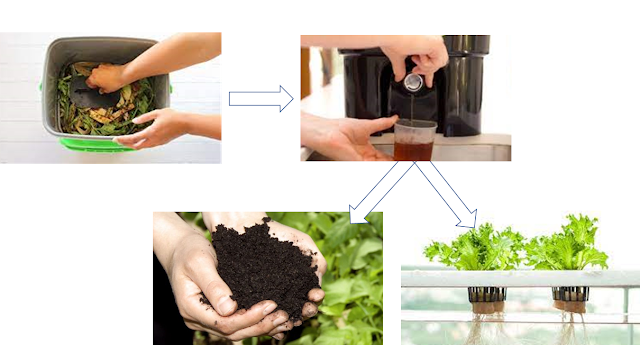
Bokashi and how it helps with waste management
Waste management is one of the bigger headaches for urban planners and local authority. In most places, food waste is not considered as its own entity, but rather dumped at the landfill together with the other non recyclables. This is detrimental to the environment because of the subsequent aerobic breakdown of the organic matter, releasing CO2, CH4 and other emissions. Instead, why not transform the food waste into something useful, before it even leaves the house? Food waste is not trash, but a resource.
A way to transform food waste into something useful, is through bokashi. Bokashi is a form of composting using Effective Microorganisms (EM) to break down organic matter anaerobically through fermentation. The result is a solid component that will turn to soil quickly after being buried and a nutrient rich leachate that can be tapped from the bokashi bins during fermentation. The process works without air, and the nutrients are retained within the finished product as the system is closed. Both the solid waste and leachate (also called bokashi tea or liquid) are nutrient rich and contain EM. This makes it ideal as a soil enhancer and fertilizer.
The fact that the system is closed is one of its greater advantages, since it will not smell or attract vermins. Additionally, the release of greenhouse gasses is minimal. This makes bokashi ideal for people who live modern life in apartment blocks who want an easy and effective way to handle food waste, or small scale gardeners who want to use a sustainable fertilizer on living soil.
Bokashi originated in Japan and has a long history as a way to deal with organic waste without the attraction of vermins and smell. First they used ingenious microorganisms, who occur naturally, to ferment organic waste under semi-anaerobic conditions. These made the basis for the EM formula of multiple complimenting microorganisms made by Dr. Teruo Higa in the 1980 's (EMRO, 2016). Today EMRO has EM under their trademark, though there are alternatives and “DIY” options available. Before using the EM, they need to be activated through a medium. This could be rice- or wheat bran, together with sugar molasse and water. Either this process can be done at home, or you can buy an already made EM bran (also called bokashi bran). Commercially most bokashi brans contain EM-1™ from EMRO, and it is considered the most effective composition of microorganisms available on the market.
EM -1™, which is the original formula by Dr. Teruo Higa contains:
Lactobacillus plantarum
Lactobacillus casei
Saccharomyces cerevisiae
Rhodopseudomonas palustris
Rhodospirillum rubrum
These are lactic acid bacteria, yeast and phototrophic bacteria (EMRO 2016). It is important to understand that these alone don't ferment the food waste, rather they activate microorganisms already present, and together with them ferment the organic matter. This process continues after the EM is added to the soil through the leachate or compost, and contributes to a healthier soil microbe community.
What goes into the bin?
Another advantage of bokashi is that everything goes in the bin, except for liquids such as milk, sauce, soup and yogurt. The point is that the content within the bucket shouldn't be too wet. Meat-, fish-, and shellfish waste can be used, along with all kinds of vegetables and plant matter. It might have a faint smell of yeast or vinegar, but it shouldn’t be too noticeable or have the familiar rotting smell from composting. If it starts to smell, you know something is wrong, such as air coming into your bucket. A consideration to make is that if you have waste with high protein content you will need more EM bran, as it is harder for the microorganisms to digest it.
A general rule is that you add two tablespoons of bokashi bran per litre food waste. The food waste should only be added once every day, and after each addition, you add a layer of EM bran.0
The bin itself can either be just an airtight bucket, or a commercially available bokashi bucket with a faucet. It depends on whether you want to have the bokashi liquid as well. Solely for the purpose of food waste processing it’s okay to keep the bokashi liquid within the container until it is done fermenting. With a double layered faucet bin, the liquid can be tapped every 3-5 days, also during the fermentation process.
The fermentation process
When the bucket is full, it is time to seal it and let it ferment for at least two weeks. There's nothing wrong in letting it sit longer, in fact it might be a good idea to make sure that also the larger sized leftovers and hard-to-digest meats are properly fermented. There is no problem letting it sit for up to a year, making it ideal for households who travel (Hjerde, 2020). Before you go, put some newspaper on top to soak up some of the excess moisture. Once the two week period is over, it is also no problem for the bokashi to freeze, whether it is still inside the bucket or not.
During the fermentation, the bokashi liquid can still be tapped, however it's not a requirement. Stable temperature conditions are important for this process, and somewhere between 18-20 degrees is perfect. If need be, you can stretch it to 15-25 degrees. The process may appear mystical, as there is little visible change in the bucket when you open it after the fermentation process. The big transformation happens when you put it in soil, as the EM activates the soil microbes and continues the breakdown of the organic matter.
Transformation to soil
During the process of turning food waste to soil, the bokashi fermentation is just half of the process. The fermentation makes the solids of food waste readily available to the other microorganisms in the soil, speeding up the process of soil transformation while retaining the majority of the carbon and nutrients of the waste. This second half of the process is often called a “soil factory”, and can be done either inside or outside using the same principles. Anette Hjerde in her book Bokashi. Kjøkkenkompost for alle (2020) describes different methods to make bokashi soil. Outdoor, you can do it in raised pallet frame gardens, boxes on the veranda or directly bury it in the soil. Indoor it can be done in a simple box, without any odour.
The general method is that you have three layers in whatever type of container or place you choose to use. First one with soil, then a mixed layer of soil and the bokashi solids, before you add another layer of soil that is about 15-20 cm high. The better you mix the bokashi with soil, the faster it will transform into soil as more of the waste is in contact with indigenous soil microorganisms. It takes 3-6 weeks for it to fully turn to soil (Hjerde, 2020).